
Introduction: The Quiet Revolution in Canadian Innovation
National innovation strategies are rarely revolutionary. They often consist of incremental adjustments and siloed initiatives. What’s happening in Canada, however, is different. A fundamental rewiring of the country’s economic engine is underway, representing a significant and holistic overhaul of how the nation plans to convert its world-class R&D prowess into lasting commercial success.
This is the story of a deliberate strategic pivot. By dissecting the most significant shifts, from prioritizing commercial outcomes to launching a global talent offensive, we can see the clear outline of a new blueprint for Canadian growth. This post will break down the five most significant and surprising changes in this new playbook and explain the high-stakes bet Canada is making on its own ingenuity.
Takeaway 1: From Lab Coats to Balance Sheets
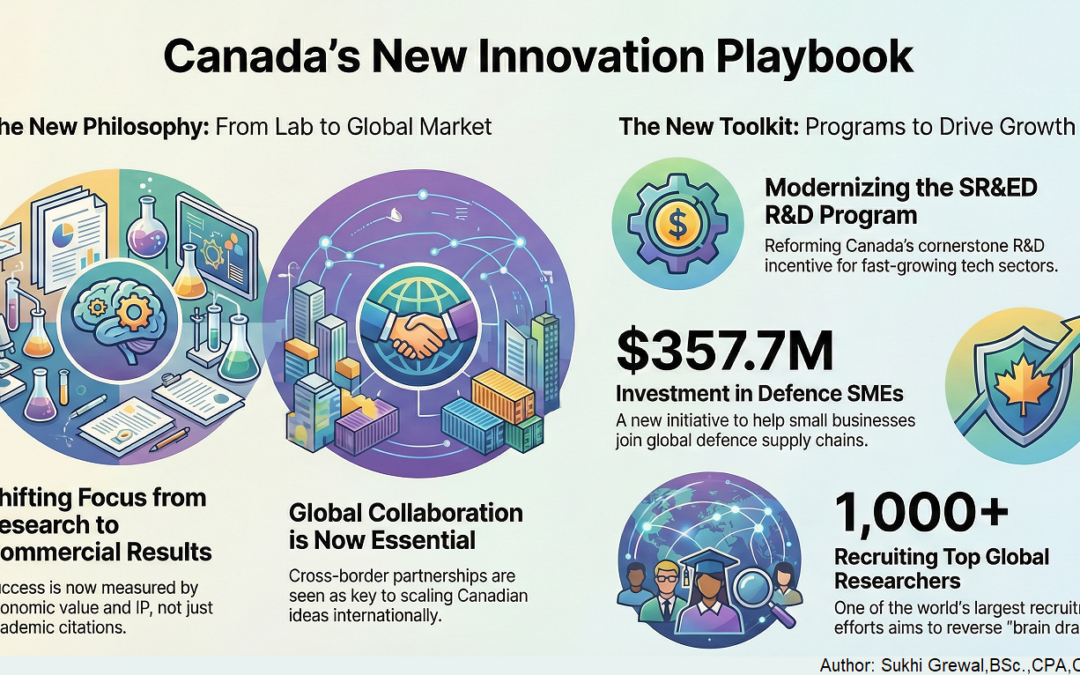
1. The focus is shifting from pure research to commercial results.
For years, Canada has grappled with its “innovation paradox”: a consistent history of producing world-class research that other nations ultimately commercialize and profit from. A major strategic shift is underway to solve this problem by moving the country away from simply funding research and toward driving tangible business outcomes.
This pivot signals that the government is no longer content to fund ideas that get monetized elsewhere. The new priority is explicitly on IP strategy and tangible economic impact. This marks a decisive move from measuring success by the number of academic citations to measuring it by the economic value created for Canada. It’s a critical change indicating a new focus on ensuring Canadian ingenuity directly benefits the Canadian economy.
Takeaway 2: Innovation Is No Longer a Domestic Sport
2. Global collaboration is now considered essential.
If the goal is to build globally competitive companies, then innovation cannot be a purely domestic affair. The new strategy recognizes that international partnership is a foundational requirement for success. This approach is designed to help Canadian firms avoid being “landlocked” by the dominant U.S. market and to build greater economic resilience through diverse global ties.
This new policy embeds a global mindset at its core, viewing frictionless access to international markets, capital, and supply chains as a prerequisite for growth, not an afterthought. This shift acknowledges that “cross-border partnerships are key to scaling Canadian ideas internationally.”
Takeaway 3: A Legacy Program Gets a Modern Upgrade
3. A key R&D program is being modernized for today’s tech landscape.
To compete on the world stage, Canada’s most promising firms need domestic support that matches their ambition. This is why the modernization of the widely used Scientific Research and Experimental Development (SR&ED) program is so critical to the new strategy.
The reforms are explicitly designed to make this cornerstone incentive more accessible and effective for capital-intensive and fast-growing sectors. This isn’t just bureaucratic housekeeping; it’s a practical step to retool a foundational policy for the realities of today’s global tech industry, where speed, capital, and scale determine who wins markets.
Takeaway 4: Placing a Strategic Bet on Defence Tech
4. There’s a new, targeted investment in defence SMEs.
Alongside broad-based support, the strategy is also making targeted bets on key sectors. The new $357.7M Defence Investment Initiative (RDII) underscores this approach, with a focused mandate to help Canadian small and medium-sized enterprises (SMEs) upgrade their productivity and integrate into global supply chains.
This initiative is more than just sector-specific funding; it is a shrewd geopolitical move. By embedding Canadian technology into stable, long-term allied defence ecosystems, the government aims to secure sovereign capability while giving high-potential SMEs a solid foothold in powerful international networks.
Takeaway 5: The “Brain Drain” Reversal
5. Canada is launching a massive global push to recruit top researchers.
The federal government has officially joined the global war for talent with what it describes as “one of the largest recruitment programs of its kind globally.” The ambitious plan aims to attract and support more than 1,000 leading international and expatriate researchers, including French speakers.
This move is a direct response to a rare strategic opportunity. U.S. funding cuts under the Trump administration, particularly for research in politically sensitive areas like climate change and DEI, have created a pool of world-class talent looking for new homes. But Canada is not alone in recognizing this opening; the European Union has launched its own €500-million effort to attract the same American researchers.
Against this competitive backdrop, Canada is positioning itself as a haven for academic freedom. Industry Minister Mélanie Joly noted that while recruitment is global, Canada’s commitment is clear at a time when “some countries are turning their backs” on science, adding that many researchers “south of the border are raising their hands.” This strategic push is designed not only to draw in global talent but to achieve a long-sought goal: reversing the Canadian “brain drain.”
As Industry Minister Mélanie Joly put it:
“We’ve talked about brain drain for a long time. Now, we have a chance to bring our people back home.”
Conclusion: Canada’s High-Stakes Bet
These five shifts, a focus on commercial results, a global-first mindset, modernized R&D incentives, targeted defence investments, and a major talent recruitment drive are not isolated initiatives. Together, they represent a deliberate, high-stakes bet on a new, comprehensive playbook for national innovation. Canada is moving to integrate every tool at its disposal, from policy reform to global talent acquisition, in a unified push for economic sovereignty and success.
With all the pieces now in motion, the defining question is no longer about the strategy’s ambition, but about its execution, will this be the decade that Canada finally solves its innovation paradox?
By: Sukhi Grewal, BSc, CPA, CGA | Tax Incentives Lead