
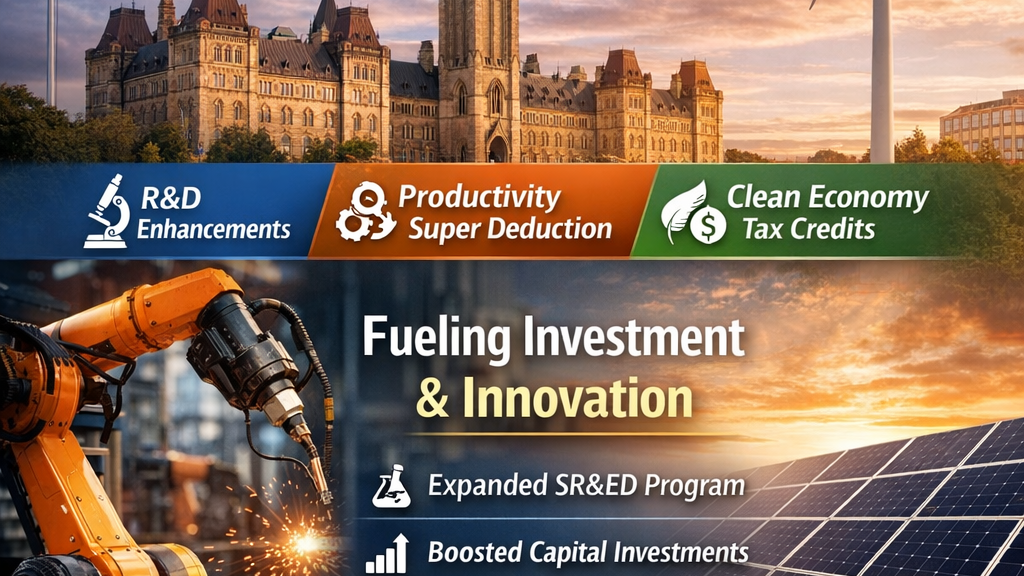
While the national conversation surrounding Budget 2025 has been dominated by the urgent, visible themes of housing and cost-of-living measures, a far more consequential story for Canada’s long-term prosperity is unfolding in the fine print. While the media remains distracted by the roof over our heads, Bill C-15—the Budget Implementation Act, 2025, No. 1—is quietly fixing the floor beneath our feet.
Having recently received Royal Assent, Bill C-15 isn’t just another legislative update; it represents the most significant overhaul of Canada’s innovation engine room in a generation. For entrepreneurs, R&D directors, and tech-sector investors, this is the definitive roadmap for capital deployment and commercialization through the end of the decade.
Here are the five pillars of Bill C-15 that are set to transform the Canadian tech landscape.
The SR&ED Power-Up (Doubling Down on R&D)
The Scientific Research and Experimental Development (SR&ED) program has long been the cornerstone of Canadian innovation, but it has often felt stagnant. Bill C-15 initiates a “New Chapter” by effectively doubling the expenditure limit for the enhanced SR&ED rate. This change directly increases the refundable cash credits available to high-growth firms, providing a much-needed injection of non-dilutive capital.
Analysis: This move recalibrates Canada’s global competitiveness. By doubling the expenditure limit, the government is addressing the liquidity needs of firms undergoing intensive research cycles. From a strategic perspective, this ensures that high-potential companies aren’t forced to look abroad for the capital required to sustain their primary R&D functions.
“These changes represent the most significant update to SR&ED in over a decade, enhancing Canada’s competitiveness as a destination for R&D investment.”
Bringing Hardware Back (De-risking the Deep Tech Bridge)
In a strategic reversal that signals a shift away from a “SaaS-only” mindset, Bill C-15 restores the eligibility of capital expenditures, specifically technology and equipment, within the SR&ED framework. Crucially, the legislation also allows public companies to access previously non-refundable credits, a move designed to support firms as they scale.
Analysis: This is a vital correction for the “Deep Tech” sector. Innovation in hardware, robotics, and advanced manufacturing is notoriously capital-intensive. By including physical assets like prototyping tools and machinery in the credit mix, the policy de-risks the transition from lab to factory floor. Furthermore, by expanding access for public companies, the government is addressing the “scaling cliff”, ensuring that when Canadian firms grow large or go public, they have a fiscal incentive to keep their high-value operations within our borders rather than relocating to lower-cost jurisdictions.
The Productivity Super Deduction (Liquidity in a High-Rate Environment)
One of the most potent tools in this legislation is the Productivity Super Deduction. This incentive acts as an accelerated capital cost allowance, permitting businesses to deduct a much larger portion of qualifying capital expenses, including machinery, equipment, and technology upgrades, in the very year they are incurred.
Analysis: In today’s high-interest-rate environment, the cost of capital is a primary inhibitor of growth. The Super Deduction serves as a massive liquidity win by “front-loading” tax benefits. By lowering taxable income upfront and freeing up immediate cash flow, the government is effectively offsetting borrowing costs and encouraging firms to pull their investment plans forward. It is a clear signal to invest “sooner rather than later” to secure immediate productivity gains.
Frictionless Filing (Predictability vs. Red Tape)
The utility of a tax credit is often undermined by the friction of claiming it. Bill C-15 introduces a suite of administrative modernizations scheduled for implementation in April 2026. This includes an elective pre-approval process, simplified filing forms, and the introduction of targeted AI-supported claims processing to drastically reduce wait times.
Analysis: For high-growth startups, predictability is the ultimate currency. Moving away from the “audit-first, ask questions later” culture that has historically plagued the SR&ED system is a significant win for founders. The shift toward pre-approval and AI-driven efficiency allows R&D directors to plan their capital runways with a level of certainty that was previously impossible, ensuring that talent and resources flow where they are most needed without administrative delay.
The Green Tech Multiplier (Clean Economy ITCs)
Bill C-15 further integrates innovation with sustainability through the expansion of Clean Economy Investment Tax Credits (ITCs). These credits offer higher rates and broader eligibility for projects that align with the global transition to a low-carbon economy.
Qualifying projects under this framework include:
- Renewable energy equipment
- Carbon capture and storage systems
- Energy efficiency upgrades
- Clean technology manufacturing
Analysis: By pairing general productivity incentives with targeted green credits, Canada is creating a “strong environment” for sustainable innovation. This dual-track approach ensures that as companies modernize their infrastructure, they are also positioned to lead in the global clean-growth market. It effectively turns environmental compliance into a competitive commercialization advantage.
Conclusion: From Roadmap to Reality
The measures embedded in Bill C-15, from the SR&ED enhancements to the Productivity Super Deduction, signal a fundamental shift toward a predictable and generous R&D ecosystem. The government has provided the fiscal tailwinds; the focus now shifts to how industry leaders will utilize them.
We have moved from the legislative phase to the implementation runway. For Canadian founders, researchers, and investors, the roadmap is clear. The critical question for 2025-2026 is no longer about the availability of support, but about the speed of execution: How will you pivot your strategy to leverage these new tools and accelerate your path to global markets?
At GPA LLP, our team includes a dedicated SR&ED Tax Incentive specialist who works closely with businesses to identify opportunities and maximize claims.
If you would like to discuss how these changes may impact your innovation strategy or R&D planning, we encourage you to book a consultation with our SR&ED Specialist, Sukhi Grewal, here.